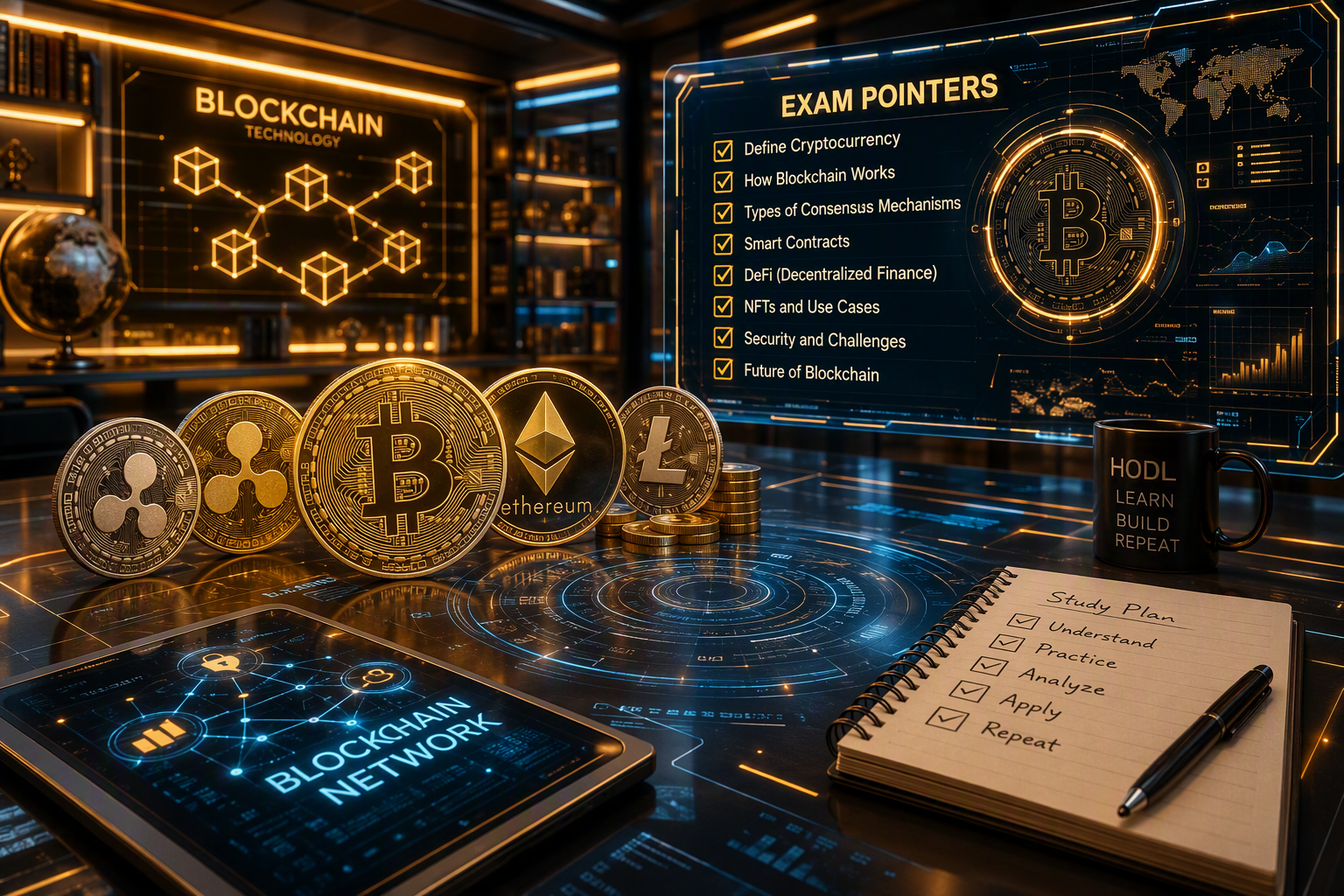
Key Highlights
- Cryptocurrency is a kind of digital currency. It stays safe because of blockchain technology and cryptography.
- It lets people do peer transactions without a central authority or a bank in the middle.
- Some benefits of cryptocurrency are faster payments across countries, more transparency, and more chances for financial inclusion.
- But there are many risks, like high volatility, fraud, cyber threats, and harm to the environment due to bitcoin mining.
- In India, it is not legal tender. The Reserve Bank of India is careful with it in current affairs.
- For UPSC GS3, you need to know about digital currency, the rules for regulation, how CBDC is different, and all other things for comparisons in the exam.
Introduction
Cryptocurrency is now a big topic for UPSC GS3. You can see it is linked to the economy, technology, security, and current affairs. A cryptocurrency is a type of digital currency. It uses blockchain technology. With this, people can send money to others. A central bank does not control this money.
If you are getting ready for exams, you need to know that this topic goes beyond just what it means. It is also about policy. It looks at rules, taxes, financial stability, and how money is changing in this new digital time.
Understanding Cryptocurrency for UPSC GS3
Digital currency is money that you keep and move online. A type of digital currency is cryptocurrency. It uses blockchain technology. This means no single central authority keeps the records. A network of computers work together to track everything. Because of this, digital currency matters a lot in science, technology, and the economy.
For UPSC GS3, you have to connect cryptocurrency transactions with bigger things. This can be about financial inclusion, cyber risks, tax problems, and the rules that are there. The parts that come next will talk about what cryptocurrency transactions are, how they have changed, and the main technology behind them. This will help you get a clear idea of cryptocurrency transactions and financial inclusion.
Definition and Basic Concept
Cryptocurrency is a digital currency. People use it as a medium of exchange. It works using blockchain technology. Special ways check each move to keep it safe. Algorithms help with the creation of monetary units. Bitcoin was the first big digital currency that was not controlled by one person or group. It came out in 2009.
You can think of virtual currency like money on the internet. It is not managed by central banks. A bank does not keep the record of that transaction. A group of computers do the job, and they update shared transaction records. That is why people say cryptocurrency is not controlled by one group.
One thing you need to know for exams is this. Cryptocurrency is not the same as legal tender. Legal tender is money you can use to pay debts in a country. The Indian rupee is a legal tender. In some places, people can buy, sell, or keep private cryptocurrencies. But that does not mean these are legal tender.
Evolution of Cryptocurrency Worldwide
The world got to know about digital currency in 2009 when Bitcoin began. It became the first big digital currency that was not led by any central authority. Bitcoin uses blockchain technology. With this, people can send money to each other. They do not need the banking system or any company to be in charge.
As more people started to use crypto assets, many new coins came out. There are now coins for payments, stablecoins, utility tokens, and governance tokens. Each one tries to fix different problems. Some of them help people pay for things. Some of them work with smart contracts. With all these new coins, people can now use crypto assets in many new ways. They are not just for one thing now.
There was also a big change with the talk about bitcoin mining and how new money is made. In some setups, new coins get made when computers do a lot of hard work. This takes a lot of computer power. As time went on, more people wanted to invest in it. But people started to think about how much energy it uses, what rules should be in place, and how it affects financial stability.
Core Technology—Blockchain Explained
Blockchain technology is used by most cryptocurrencies. It makes a ledger that no single person controls. The transaction records are put into blocks and these blocks are linked together. Once the records are checked and added, it is hard to change them. This gives the system transparency and lasting strength.
What makes this good is that users can do peer transactions with each other. A central authority, like a bank, does not sit in the middle of every exchange. A network of computers checks things and keeps the ledger up to date instead of just one group. This makes it easy for people to send value or money to others. You do not need help from a single group or company. It also means people do not have to depend on one place to get things done.
Validation uses a consensus mechanism. The network uses this method to agree on which transactions are real. Only those go into the record. For UPSC, remember this link: blockchain keeps the data, the network checks this data, and the consensus mechanism helps to keep things safe.
How Cryptocurrency Works
Cryptocurrency transactions use blockchain technology. When you want to send digital currency, you move it from one wallet address to another. A bank does not check these transfers. Instead, a consensus mechanism checks all of them. Public and private keys help to keep your money safe. They also let you move your funds whenever you want.
Unlike how it was done before, the network now helps watch and keep record of all moves. This is why you need to know the main parts, how it matches up to fiat currency, and the ways these moves are made. Let’s go over these key points one by one.
Key Features of Cryptocurrency Transactions
Cryptocurrency transactions take place when people send a digital asset on a blockchain network. The facts about these moves are usually put on a public list. Still, it can be hard to know who did what. This is one thing that makes cryptocurrency transactions not the same as bank transfers.
A few features stand out in peer transactions:
- People can send money to each other fast. There is no need to use a bank or a go-between.
- It can cost less to send money to someone in another country. Transaction fees are often lower.
- The network keeps a note of each step. All the transaction records are saved on the blockchain.
- To send money, people use cryptocurrency wallets. They will need their private keys for this.
Easy-to-use wallets can still have risk. A hot wallet is simple to use, but it is also easy for thieves to get into. A cold wallet is safer, but some people feel that it is not as quick to use. For UPSC, you have to connect speed, how well things work, and problems with safety. You also need to care about consumer protection.
Cryptocurrency vs Traditional Currency Mechanisms
Traditional money and cryptocurrency both let people buy things or trade value. But, they work in different ways. Fiat currency is made by central banks. A central authority looks over it and makes sure it is backed up by the state.
On the other side, cryptocurrency uses blockchain technology. There is no central authority that makes new coins or handles your usual transfers.
When you answer exam questions, it is good to give a simple comparison. This can help you make your point clear and quick.
| Feature | Cryptocurrency | Traditional Currency |
|---|---|---|
| Issuer | Usually no central authority | Issued by central banks |
| Legal status | Generally not legal tender by default | Legal tender within a country |
| Record system | Blockchain technology ledger | Banking system and official records |
| Validation | Consensus mechanism | Centralized institutional verification |
| Form | Digital form | Physical and digital form |
This difference matters when people talk about government in current affairs. One side trusts the government and its rules. The other side trusts code and people working together in a network. Here, code is used to check things. That is why people talk so much about tax rules and the need for financial stability.
Proof-of-Work, Proof-of-Stake, and Other Consensus Methods
A consensus mechanism helps people check new entries in a big shared database. It keeps the system safe for everyone. In cryptocurrencies, it is how people pick blocks to put in the system. It also helps them agree on entries that are good. The two main types are proof-of-work and proof-of-stake.
Under proof-of-work, miners use computer power to solve complex mathematical equations. The miner who solves the problem first checks the block. They get a reward for that. When people talk about bitcoin mining, they often mention this process. Many say this method uses a lot of energy.
Proof-of-stake is different from proof-of-work. In proof-of-stake, the people who are chosen are called validators. They get picked because they have coins or tokens. You do not need to use much computer power for this. Proof-of-stake is seen as better for energy use.
For UPSC, it is important to remember this: proof-of-work uses a lot of resources. Proof-of-stake helps to bring energy use down. Both are used as a consensus mechanism.
Types of Cryptocurrencies
Cryptocurrencies are not all the same. Now, there are many types of digital currency. They can do different things. Some of them are made for payment. Some help keep prices steady. Others are used on platforms for things like smart contracts or helping to run how things work.
For UPSC GS3, you need to know about new asset classes. These include Bitcoin, Ethereum, bitcoin cash, stablecoins, and CBDCs. You have to see that there are big coins and there are also new coins. Some digital money is backed by the state.
This part will help you tell the main coins from the new coins. You will also learn how to find digital forms that the state supports.
Bitcoin, Ethereum, and Major Coins
Bitcoin is the most well-known digital currency in the world. It was also the first one that many people started to use. Bitcoin works on a network where bitcoin mining takes place. People get bitcoin by using computers to solve problems. When they do this, they help approve every transaction and add another block to the chain. There is only a certain amount of bitcoins that can be made. Because of this, people feel it is good to keep bitcoin and maybe sell it later.
Ethereum is not only for sending payments. It also lets you use smart contracts and apps that do not need one big company or control. This makes it important, not just as a token, but as the main place for things made on the blockchain. When you answer your exam questions, remember this difference. It can help you show you know more about smart contracts.
Other big coins are Litecoin and Bitcoin Cash. A lot of people put these coins with others that are traded on cryptocurrency exchanges. For UPSC, you can say that more people now think of them as asset classes. But there is still a lot of price change in these coins, and each country has its own rules for how to use them.
Stablecoins and Altcoins
Stablecoins are crypto assets made to keep their price the same. They are often tied to cash, bonds, or things you can hold. The main goal of stablecoins is to make sure their value stays more steady than other crypto assets.
Altcoins are coins that are not Bitcoin. They are a kind of digital asset. You can use these coins for many things. People like to use them for different reasons.
- Stablecoins like USD Coin and Tether try to hold their value equal to the US dollar.
- Utility tokens let you get access to a platform or service.
- Governance tokens let people who own them take part in making the rules.
- Some altcoins can be used for payments, storage, or making smart contracts work.
For the UPSC exam, you need to know why each cryptocurrency is there. Not all of the coins work just like Bitcoin. Some coins, like stablecoins, keep their value steady all the time. Other coins, which people call altcoins, can do things like help run a service, support an investment plan, or be used inside a network. It is good to remember these differences for both the Prelims and Mains.
Central Bank Digital Currencies (CBDCs) vs Cryptocurrencies
Central Bank Digital Currencies are just digital forms of fiat currency. Central banks make these. They are not like private cryptocurrencies. This is because they have government backing. The money is real but it comes in a digital form. In India, the Reserve Bank of India has started to test their retail CBDC. People also call it the digital rupee or e-rupee.
This is the main difference. A CBDC is legal tender. It is put out by the group that handles the money for the country. Most private cryptocurrencies do not have that same status. They are not legal tender. They are not supported by the government.
For UPSC, see how control and trust matter. Central bank digital currencies get power from the government. These work as an official medium of exchange. Cryptocurrencies are based on trust in the network, market demand, and the users. Because of this, it can be hard to make rules that support financial stability.
Benefits and Advantages of Cryptocurrencies
Cryptocurrencies are getting noticed by people because they are a new way to move and use money. A lot of supporters say this helps with financial inclusion. They believe these coins give more clear deals and make costs go down, especially when people need to send money across borders. In places where there are many people without good banks, this is seen as a good option.
You still need to look at the benefits with care. See how they fit into the big picture. For UPSC, try to link these good points with how blockchain systems, peer networks, and financial services work in real life. The next parts show the main good sides in a clear way.
Financial Inclusion and Accessibility
One main reason people like digital currency is that it can help more people join in financial services. In many places, not everyone can go to a bank easily. Some people feel they are not treated well in normal banks and other places that offer financial services. A digital currency system that works on phones can make things easier. It can help people get financial inclusion. This way, more people can use simple financial services.
This is important for Indian society. People want to feel included in development. When there are not enough banks, or when people do not trust the banks, blockchain systems can help. These systems could be a new way for people to move money or save money. That is why there is talk about it in both money and tech areas.
Some game-changing decentralized apps give people loans, savings, and services that feel like insurance. You do not have to go into a regular bank or even have a bank account to use them. Their goal is for more people to get these tools. But there are some issues to think about. Prices go up and down a lot. There are not strong rules on how things work. There are also concerns about consumer protection that the people behind these apps should look at.
Transparency and Security
Cryptocurrency systems get people to look at them because they are open. Transaction records are on a public blockchain ledger that anyone can see. A lot of these systems use open source code. People can read and check this code. The process is very open. You do not see this in closed financial systems.
A few advantages are often highlighted:
- When people can see transaction records, it is easier for them to follow where the money goes.
- Using cryptographic methods keeps transfers safe. It also lets people check who is making a move.
- A peer network means people do not have to trust just one big group for this.
- Open protocols let everyone look and check what is happening, which helps build trust.
Even with this, you should not forget about security risks. The open records don’t mean people will be safe from harm. There can be wallet theft, exchange hacks, and misuse. When you write UPSC answers, you have to match the points about openness with the need for consumer protection and strong checks.
Cross-border Transactions and Speed
One thing people like about cryptocurrency is that it lets you send money to another country fast. A lot of money transfers with banks can be slow. There may be several banks in the process. You can end up paying a lot of fees. But with crypto, you can send money almost right away. It can move to other countries quickly.
This helps cut down on transaction fees and makes money move faster from one person to another. This is useful when people send money to someone else. Because of that, some feel that crypto could make the financial system better for all of us. Now, as the world is more connected on the internet, speed can be a big thing for both policy and the market.
From a worldwide look, fast trades are good for users, traders, and businesses. They want deals to settle quickly. This speed helps people get and send money in less time. But there are risks that come with it too.
Regulators worry about how to watch these trades. It is hard to track when everything moves fast. Quick trades can help with money laundering since people may hide where the money goes or comes from. There is worry about financial stability. If things happen too fast, the whole system might feel stress. So there are both good sides and risks with oversight, stopping money laundering, and keeping markets safe.
Risks and Challenges in Using Cryptocurrency
The rise of cryptocurrency has brought some big risks. You have to know about prices going up and down, safety issues, and what it can do to the environment. This is important for you if you are preparing for UPSC. These problems can affect people who invest, people who make rules of the financial system, and everyone in it.
A good answer should not think that cryptocurrency is only something new or is only bad. It can be a way for some people to do well, but it can also cause trouble. This text will talk about the major things people worry about. These are big changes in prices, scams and theft, and the large amount of power used to mine coins.
Volatility and Market Fluctuations
Cryptocurrencies are famous for their high volatility. The prices of these coins can jump up fast or fall down just as quick. There is not a main group to keep their value stable. This makes them different from normal money that comes from countries. Government cash follows rules and is managed by leaders.
For people who invest money, these price changes can be risky. For those who make rules and plans, the worry is even bigger. If there is widespread adoption of crypto, big unknown money flows and prices that go up and down fast can bring fiscal risks. These changes can also hurt some parts of the formal financial system. That is why this problem is not just for people who want to make fast money.
Many places say that crypto assets with no rules may cause financial instability. People often mention El Salvador because it made Bitcoin legal tender. For the UPSC exam, it is important to know that crypto is a new type in asset classes. It is not stable money.
Security Concerns and Fraud
Security worries are still one of the big problems with the use of cryptocurrency. A blockchain is strong and hard to break. But there are other risks. People need exchanges, service providers, and crypto wallets for their accounts. Hackers or people with bad intentions could try to get into these places.
A big risk for anyone who has a digital asset is their private keys. If you lose the private keys, you may not get your money back. If someone gets them, they can take your digital asset, and you might not get it back. Hot wallets are even at more risk. This is because they are on the internet all the time.
Fraud is a big worry here. It can be hard to keep track of these transactions. This is because people can stay hidden or use fake names. Some people may use this system for money laundering. Others might use it to fund terror. For UPSC, you can say that these security problems show why the country needs to license service providers. It also shows there is a need for strong AML/CFT rules. Plus, it shows we need better protection for people who use crypto.
Environmental Impact—Energy Consumption
Many people say bitcoin mining may be bad for the environment. In proof-of-work systems, computers use a lot of power to solve tough tasks. This takes a lot of electricity. So, some feel it does not help with climate goals or being green.
Why does this matter so much?
- Bitcoin mining uses a lot of power.
- This high use can be hard for energy security.
- When more power is used, it can let out greenhouse gases.
- The quick growth of crypto assets may hurt net-zero goals.
For the UPSC, it is good to link this issue with both the environment and the economy. The problem is not only about climate. It is also about how rare energy sources be used. Because of this, people talk about proof-of-stake. Proof-of-stake lets us use less energy than proof-of-work systems.
Regulation and Legal Status of Cryptocurrency in India
In India, rules for digital currency are changing. The Reserve Bank of India speaks about price changes and how they may affect the country’s financial stability. The people who make the rules are looking into an official digital currency bill. There are talks about how to handle digital currency and what is the present status of cryptocurrency.
For the UPSC, be careful not to make strong statements. Cryptocurrency is not legal tender in India. But people still talk about it often in policies. You should know why the RBI has concerns. There are also tax steps, debates about the draft bill, and how the Supreme Court has been involved in this.
RBI Policies and Guidelines
The Reserve Bank of India is very careful with cryptocurrencies. The bank is worried because the prices of these assets can go up and down quickly. There can be a lot of risk when people trade them. This risk may hurt financial stability in the country. In your exam answers, you need to say that the Reserve Bank of India wants to be careful. This is the main idea the bank has about cryptocurrencies.
The RBI has begun an e-rupee pilot. This is the central bank’s own digital currency. It shows that the RBI is open to digital change. Their main worry is about private cryptocurrencies. These are not regulated. The concern is not with digital payments overall.
The policy debate is now about how to manage the official digital currency bill. For UPSC, it is clear the RBI says yes to a digital form of money that is controlled by the government. But RBI is not sure about private cryptocurrencies. They feel these private cryptocurrencies do not fit in the formal money system.
Legal Status under Indian Law
The status of cryptocurrency in India is not clear to many people. A main point for UPSC is the law says cryptocurrencies are not legal tender. This means you cannot use them like the Indian rupee to pay for things or clear debts.
Right now, this issue is still there because there is not a single, clear law for all crypto. People talked about a draft bill called the Banning of Cryptocurrency and Regulation of Official Digital Currency Bill, 2019. That draft bill tried to set rules to limit mining, holding, selling, trading, making, throwing away, and the use of cryptocurrency. This was meant to bring in the idea of official digital currency and give some shape to a more comprehensive crypto law.
The Supreme Court is a big part of the talk when people discuss legal issues in India. In your exam answers, do not make things sound bigger than they are. Be clear and get right to the point. There has been a lot of talk in India about what to stop and what to allow. People debate about this all the time. Cryptocurrencies are not legal tender in India. The sale of cryptocurrencies keeps happening, but the rules change a lot. Many people want to see how things will turn out.
Government Stance and Recent Developments
The Government of India does not fully accept cryptocurrency yet. It is taking small steps right now. In current affairs, the government is looking at how to handle the risks that can come with crypto. It is trying to make a bigger plan for how to use it. A group of officials is thinking about how crypto can change things like tax, rules, and working with other countries.
India, while it led the G20 group, made some big moves for crypto assets. The country worked to start a worldwide plan to help manage how people use crypto. India said that companies offering crypto services should have licenses. It also wanted to use rules from the Financial Action Task Force, as these help stop money laundering and keep people safe from crimes. All this shows that India supports team work when it comes to checking on crypto assets.
Another thing in the Budget 2022-23 was to put a tax on cryptocurrencies and NFTs. If you sell or move these, you have to pay a 30 percent tax on your income. Also, people are still talking about the official digital currency bill and how to set up rules for it. This changes how people feel about private crypto, the digital rupee, and the rules for the official digital currency.
Societal Impact of Cryptocurrency
Cryptocurrency has brought changes to indian society. It has made people talk about new ideas, taxes, safety for people, and what money will be in the future. All over the world, it is changing how people pay for things, where they keep their money, and the rules for money.
For UPSC, you have to look at the topic by thinking about its good points and the problems it can bring. A digital asset can change the way people feel and think. It can impact how much they trust groups and how the state’s money is used. The next parts show how this changes things in the country and in the world.
Effects on Indian Economy and Society
In Indian society, more people are talking about digital currency now. Investors, students, and people who use technology are showing interest in it. The idea of cryptocurrency has helped people learn about blockchain, digital payments, and new ways to use money online. Because of this, the topic is now seen and talked about not just by financial experts, but also by others across the country.
At the same time, there are some big worries. People can get hurt if prices are guessed without any rules. Scams and hacking can hurt regular people. If crypto becomes more popular with no steps to keep it safe, it can put stress on the financial system. It can also make tax, rules, and watching money moves harder.
So, the impact of cryptocurrency in India is mixed. On one side, it supports new ideas and lets more people join the money system. On the other side, it brings worries about financial stability, illegal activities, and consumer protection. If you are preparing for UPSC, you should show both views in a fair way and think about the policies.
Global Perspectives—Social and Economic Shifts
Cryptocurrency has changed how people look at money. It has shaped how we pay and how we invest. The, it has made new asset classes. This is new for the world. It has helped people try new things in systems where there is no central control. Businesses, traders, and people who make tech now see blockchain networks as useful tools for the economy.
The world has not acted the same way. The response by each country is different. Some are open to it. Some are not sure and feel doubtful about it. People worry about sudden changes in price, money being hidden, use for bad things, and missing taxes. Because of this, it is important for countries to work together as a group.
The Financial Action Task Force is in the news a lot these days. Its rules about anti-money laundering and stopping terror finance are now important in many places. You hear people talk about these rules when they talk about crypto assets, too. For the UPSC exam, you need to know that cryptocurrency is not just a topic about technology. It is linked to a larger government issue that is global.
Strategic Crypto Reserves in Current Affairs Context
The idea of a crypto reserve is talked about a lot in current affairs. It means that a country or group keeps cryptocurrency in its reserves. This tells us crypto is becoming a bigger part of the global talk. People now see it as one of the new asset classes.
For UPSC, you need to pay attention to the main ideas and not just guesses. A crypto reserve can make people feel unsure about the financial system. This is because values can change very quickly. A country may face risk with these assets, as cryptocurrency prices change a lot. This makes handling a reserve a big issue for policy.
This idea connects to bigger questions in current affairs. Should governments treat crypto as something they need to own and use? Or should they just make new rules and taxes for it? People are still having talks about this now. It is still a topic in the news, and there is no agreement on it in all parts of the world.
Potential Applications Beyond Currency
Cryptocurrency and blockchain are not just for payments. They also help the growth of fintech, smart contracts, and digital asset use in many places. This is one reason why UPSC can ask about their role in the bigger part of the digital economy.
Blockchain-based systems are used for more than just being a medium of exchange. People and companies now use them in supply chain management, lending, healthcare, voting, and investment markets. The next sections will show that these uses are about much more than simple buying and selling.
Crypto in Payments and Fintech Innovation
Cryptocurrency is a form of payment. It is new and moves past what banks can do. People can send money to one another with it, and they do not have to use a bank. You can send money anywhere in the world this way. It does not always need a middleman. Many people say it is part of fintech innovation.
Blockchain is very useful in financial services. The technology can help people finish settlement faster. It also helps with tracking guarantees, and people can see transactions as they happen. Because of these changes, businesses save time and money when they use digital networks for transfer and settlement.
Examples from the collected material show that more of these systems are now in use. JP Morgan uses JPM Coin. It helps them finish transactions between big clients in seconds. This used to take a few days. For the UPSC, you can say that this shows how crypto-linked systems are changing financial services. This happens even though the use of cryptocurrency by normal people is still being talked about.
Applications in Supply Chain and Governance
Blockchain technology does more than just help with money trading. It can be used in a supply chain to help firms track goods in the best way. Blockchain technology keeps transaction records safe. These records cannot be changed by anyone. Firms use this system to follow movement of items. It lets them see who owns each item and to confirm all of the details. This helps cut down on problems and saves time for them.
Blockchain is used in many ways, not just in money. A big use of blockchain is in how things are managed or the way things work. Because it gives clear and safe records, it can help keep public records in order. When trust and good records are needed, blockchain can do a lot. People in Andhra Pradesh already use this. They use blockchain to keep patient data safe. It also helps stop cheating and makes sure land records are correct.
Another example where blockchain technology is being used is in voting. The Election Commission of India wants to use blockchain to let people vote even if they are not near their hometown. For UPSC, these uses show that blockchain technology can help us change the way we run the government and move products from one place to another. It can make everything more honest. This stops people from changing records without permission. It also helps to keep good and strong records in many places.
Uses in Investment and Speculation
Cryptocurrency is mostly tied to investing and guessing about price moves now. A lot of people want to get into it because prices can go up or down fast. They think there is a chance to make big money if things go right. This makes crypto assets very active in the market. You will see a lot happening with these assets on exchanges and trading platforms.
You should keep investment and use apart. The idea is for cryptocurrencies to be a way to pay or use with a service. But, many people focus on what they can get by guessing prices. The price can go up and down often, so there is some risk. New things like options and futures also come up, which make it harder to know what will happen and bring more risk.
Crypto is one of the new asset classes. The price of it moves up and down a lot. This high volatility makes it different from many other types of investments. There are unclear rules for it, and the risk of fraud is also high. Because of these things, investing in it is not like other assets. A lot of people want to invest, and this helps even more people get into crypto. At the same time, it shows us that we need strong checks and that people should be careful and know what they are getting into before they invest.
Prelims and Mains Pointers for UPSC GS3
For UPSC GS3, you have to learn about cryptocurrency with simple facts. It is good to know both sides of the topic. In the Prelims, make sure you know what cryptocurrency means, main points, the difference between cryptocurrency and CBDC, and rules in India. For Mains, you must write the answer step by step. Start with the good parts, then talk about what can go wrong, and end with steps the government is taking.
Good answer writing practice helps you turn tough text into simple, clear points that matter. In the next parts, you will see topics that can show up in exams. You will also find out how to handle these questions and which digital currency words are good for quick review.
Key Concepts Likely Asked in Exams
UPSC wants to see that you know and use different ideas. When you get ready, know how cryptocurrency works. Think about what makes state leaders feel worried about it. See how it is not the same as digital currency made by the state. Make a list of short notes. Write what these words mean, how the tech works, and talk about how it can change rules and plans.
Important key concepts to revise include:
- A cryptocurrency is a kind of digital currency. It works as a medium of exchange, like money. However, it is not something you can touch. You can use it to pay for things, send money to people, or keep it as an asset.
- Blockchain technology is the key system behind most digital currency. It keeps track of every exchange in a way that is open and safe. A consensus mechanism means people agree on the record in the blockchain, so it can be trusted.
- A cryptocurrency is different from fiat money. Fiat money is the paper bills and coins given by a country, like dollars or euros. A CBDC, known as central bank digital currency, is also digital and controlled by the government. A cryptocurrency is mostly not under any single government’s control.
- Financial inclusion, innovation, and regulatory risk have to do with digital currency like cryptocurrency. A digital currency and blockchain technology can give more people a chance to get into the financial system. It can add new ways to use money. There can be risks with rules if these are not clear or if people misuse the system. Now, governments are still working to find the best way to use it.
Go over topics that come up a lot in exams. These things include Bitcoin being the first big cryptocurrency. You should know about how the Reserve Bank of India began a digital rupee pilot. There is a 30 percent tax on income from transfers. Other important points are price ups and downs, people using money in wrong ways, and how much power it takes to run everything. All these matter for your exam.
Model Sample Answers
A good Mains answer can start with what digital currency means. A digital currency, like cryptocurrency, is not controlled by one group or person. It stays safe because of codes, which is called cryptography. Every move gets written down on blockchain.
Next, you can talk about how it works. People send money to each other right away, without needing anyone in the middle. A public list keeps track of all the moves. A group must agree before any change becomes final.
After, you should talk about what is good and not good about cryptocurrency by giving different points.
For good answer writing practice, start with a balanced approach. Talk about fast cross-border payments and more transparency that come with digital currencies. They can help more people get banking services.
At the same time, there are worries. Speak about high volatility, fraud, money laundering, and energy use. These can risk financial stability.
In the end, say India takes a careful approach. India also uses the digital rupee as another choice.
For practice in a personality test or interview, know that you may have to share what you think. Sometimes, they may ask if India should ban, control, or check crypto. It is a good idea to say that you want new ideas, but you also want consumer protection. You can say there should be taxes, countries working together, and clear rules. Do not just give a short answer or an easy one. Take your time to choose your words.
Important Keywords for GS3 (blockchain, financial inclusion, digital currency)
To do well in UPSC GS3, you have to know about blockchain technology, digital currency, and financial inclusion. Blockchain technology is a way to keep records. It does not use one main spot to control everything. All people can see and check each transaction. Because of this, things stay safe and clear. This is the reason why it is important for cryptocurrency.
Financial inclusion is to make sure every person can use financial services. It is why digital currency is so important. With new forms of digital money, people without a bank can join and feel included in the money system.
Digital currency, like the digital rupee made by the Reserve Bank of India, can change financial systems in the world. There will be new chances and new issues because of this change. Economic policy will feel the effect. Banks and people will have to work out the best way to use it.
UPSC Previous Year Questions on Cryptocurrency
Questions from old UPSC exams can be helpful to see how people talk about cryptocurrencies over the years. The test often covers blockchain technology, legal tender, and how private cryptocurrencies may affect the financial system. It checks what you know about cryptocurrency transactions and the rules that are there. There are questions about digital currencies like the digital rupee. By looking at these questions, you get to know what areas get the most attention. You can see that you need to understand crypto assets well. The right knowledge is important to handle any fiscal risks and rules that come with them.
Analysis of PYQs
Looking at old exam questions helps you see what the UPSC expects you to know about cryptocurrency. Many questions ask about blockchain technology and how it can help with financial inclusion. This shows there is a big focus on these topics. Questions often mention digital currencies like the digital rupee. This tells you that having knowledge about rules and how these coins affect financial stability is important for you. Studying these question patterns helps you prepare in the right way. It also makes you stay updated with current affairs around digital assets.
Trends and Areas of Focus
Key trends are shaping the way people talk about digital currency and blockchain technology. This is important for UPSC candidates. There is a lot of focus on blockchain technology because people feel it can make transaction records safer and clearer. The hope is to improve transparency and security.
Central banks are thinking about digital currency, such as the digital rupee. This move could help more people use financial services, even those who never had access before. So, financial inclusion is now a big part of the conversation.
Rules for digital currency are also seeing changes. The Official Digital Currency Bill is getting a lot of attention. There is talk about what a comprehensive crypto law should include. Many agree that a good law is needed to handle risks and keep things fair and stable.
Answer Writing Tips for Crypto-Related Questions
To do well in your exams about cryptocurrency, make sure your answers are clear. Start by telling what key words mean, such as blockchain and digital currency. This helps show that you understand the topic. Use facts from the news about the Reserve Bank of India and its rules. Also, talk about what is happening now with the digital rupee in India.
You can use real-life examples in your answer. One example is El Salvador, which made Bitcoin a legal tender. This makes your points easier to understand. Remember to talk about the risks with cryptocurrencies, like financial instability. This shows you know how it can affect people and their money.
Conclusion
Knowing about cryptocurrency is important if you want to do well on the UPSC exam. The digital world is changing very fast. Digital coins like the digital rupee are now becoming popular. So, you need to understand blockchain technology and how the financial system and rules work.
Get to know more about cryptocurrencies, including private cryptocurrencies, and learn if they may become legal tender someday. This will help you feel ready for the exam. It is good to keep an eye on your current affairs and pay attention to new changes. These things can make your answers much stronger. If you follow all the fast updates, you will be able to talk about new ideas and risks in India’s financial system. This will help you with your studies and when you write your exam answers.
Frequently Asked Questions
What is the current legal status of cryptocurrency in India?
The status of cryptocurrency in India is not clear right now. The Reserve Bank of India has not banned crypto assets, but it has warned people about using them. Talks about rules for crypto assets are still taking place. These talks could change how the Reserve Bank of India will control crypto assets in the future.
How does cryptocurrency differ from central bank digital currencies?
Cryptocurrency runs on blockchain technology. It is not controlled by one person or group. CBDCs are sent out and managed by central authorities. This big difference affects how people use each and how they get added to the system. It changes what happens in the money world. Cryptocurrency is made to be decentralized. CBDCs are made to be watched over by the government.
What are the main risks associated with cryptocurrency investment?
Cryptocurrency can have many risks. The prices can go up or down very fast. The rules about it may change at any time. There is also risk because of hackers. Some people may try to trick you or run scams. You should read about all these risks first. Take your time and think well before you put money into digital coins.