
Key Highlights
- A cash advance lets you take cash out using your credit limit.
- The card issuer will often set a different limit just for this feature. This is usually lower than your main credit limit.
- You can get cash at an ATM, at a bank, or maybe by transfer.
- Interest rates on a cash withdrawal are usually higher than what you pay for normal card purchases.
- There are often fees that start right away. These can make the costs add up fast.
- A cash advance can help in a real emergency. But you should use this option with care.
Introduction
Sometimes you may need money right away and think about using your credit card. A credit card cash advance lets you get quick cash, but it works in a different way than normal card spending. Your credit card issuer can let you take money out from an ATM, request money at a bank, or move it to your account. But this can come with extra fees and interest right away. That is why you should learn the rules before you use this. If you do not have an emergency fund, this guide will help you know the costs, limits, risks, and better ideas.
Understanding Cash Withdrawal from Credit Cards in India
A cash advance lets you borrow money with your credit card instead of using it just for regular purchases. The total money you can get depends on your credit limit. Usually, only some of your credit limit can be used for cash. You can find out how much by looking at your credit card statement.
Before you do this, check with your credit card company. See what they let you do and what fees they have. Most of the time, interest charges begin at once. The usual steps to follow are easy. Look at your limit first. Pick the way you want to take out money. Know the fees before you move ahead. The next parts will show this in a clear way.
What Does it Mean to Take Money from Your Credit Card?
Taking out cash from your credit card means you use a cash advance. You do not pay a shop with this. You take money from your available credit instead. This is not the same as when you use a debit card. A debit card lets you spend money already in your bank account. A cash advance uses your credit card and not your bank account.
In practice, the steps are simple. First, look at your credit limit and the cash withdrawal amount you can use with your credit card. Next, go to an ATM, see a bank teller, or ask your card issuer how you can take out money. After you get the cash, that amount will be added to your credit card balance.
What matters most is the cost. A cash advance is seen as a different kind of borrowing. This often comes with fees. The interest also goes up fast. You can get your money quickly with a cash advance. But, you need to know this ease can get costly if you take a long time to pay it back.
Key Terms and Limits to Know
Before you take out any money, you should know the rules that control the way it works. Your card lets you get cash, but you can not always use the full amount of your credit line. Most of the time, you can only take out a small part of your full amount, not all of it.
Keep these points in mind:
- Your total credit limit is the full amount you can use on your card.
- The cash advance limit is often less, usually about 20% to 40% of the total credit limit.
- A higher interest rate comes with cash advances.
- When you take cash advance, that amount uses your credit line.
- A bigger balance will make your credit utilization ratio go up.
Yes, most of the time there is a limit to how much money you can take out using your credit card. The amount you can get will depend on your card and the rules from the place that gave it to you. You should look at your statement or read your card terms before you try to take out cash. This helps you not get a surprise with your credit card.
Methods to Withdraw Money from Credit Card
There are a few different ways to take out money using a credit card. Each way is a bit different from the others. If you want quick cash, there are several choices. You can use an ATM, go to a bank, or ask for a credit card transfer, based on what your card company offers.
Still, this is different from when you use a debit card that takes money from your savings account. Here, you are borrowing money. You are not using your own cash, and the amount shows up on your credit card bill. To help you know what to do, let’s look at the most usual ways and what each needs.
Withdrawing Cash from an ATM Using Your Credit Card
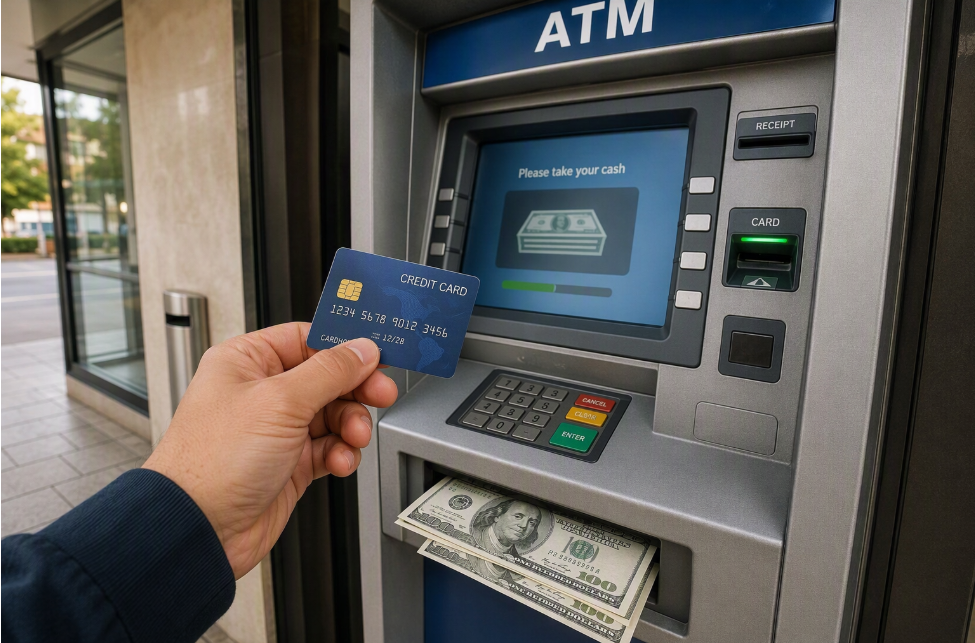
Yes, you can get cash from your credit card at an ATM if your card lets you do a cash advance. You need to have the card and know your PIN. Before you go, look at your credit card statement. This helps you know the cash advance amount you can take.
The process is simple:
- Make sure your card can be used for a cash advance at the ATM.
- Look at your statement or account info to find out your cash advance limit.
- Put your card in the ATM and type in your PIN.
- Pick the cash withdrawal choice and enter the cash amount you need.
- Keep the receipt. You may need it to keep track of the cash advance or any withdrawal fee.
If you can’t use the ATM, you can ask a bank teller for help. No matter which way you get a cash advance, you will need to pay cash advance fees right away. Also, be aware that getting cash this way costs more than making a standard purchase with your card.
Transferring Funds from Credit Card to Bank Account (Online & Offline)
Some credit card companies let you send money from your card to a bank account. This kind of move is usually seen as a cash advance. So you still may have to pay fees and start paying interest right away. If you can do this, the money can go to your checking account using either online or offline ways.
Here are common ways this may happen:
- Try to use your issuer’s mobile app if it lets you do a credit card transfer.
- Ask at a bank branch to see if your card can do an account transfer.
- If your issuer allows it, request wire transfers that are eligible.
- Always check and confirm the details of the account you are sending money to before you send it.
- Look at the transfer terms and any charges you will have to pay first.
So, is it possible to move money from the credit card to the bank account? In some cases, it is. Can you do it online? Yes, some card issuers let you use a mobile app for this. The rules, fees, and limits can be different for each card. So, always check this before you send money.
Fees and Charges Involved in Credit Card Cash Withdrawal
The biggest mistake people make is to think only about the cash they get. They do not look at the total cost. Credit card cash advance usually has several costs. You have to pay cash advance fees. There is also a transaction fee when the money shows up in your account.
Then you will see the interest charges. They start right away and are often at a higher rate than what you pay for regular purchases. You might get extra fees on your credit card statement. These could be from the ATM, the bank, or the service provider.
The next two parts will talk about these costs in a way that is easy to understand.
Standard Cash Advance Fees and Applicable Interest Rates
Most companies that give out cash advances add two main costs. These are an upfront fee and regular interest. The fee can be a set amount or a percentage of how much you take out. You end up paying whichever one is more. On top of this, the cash advance apr is almost always higher than what you pay for normal shopping.
Another thing to know is about timing. When you use a card for this, you often do not get a grace period like you do for other purchases. Interest charges start right away from day one. So, even if you take out a small amount, it can be more costly if you do not pay it back fast.
| Cost Type | Typical Charge | When It Applies |
|---|---|---|
| Cash advance fees | Usually 3% to 5% of the amount, or a flat minimum like $5 to $10 | Immediately when the transaction posts |
| Higher interest rate | Often above the standard purchase rate | Starts right away |
| Cash advance apr | Commonly higher than purchase APR, sometimes 25% to 30% or more | Applied from day one |
| Interest charges | Build daily on the outstanding advance amount | Continue until paid |
ATM, Bank, and Service Provider Charges
The card issuer’s fee is not always the full cost. There can be other parties in the same deal who add their own charges. All of this can make the total more than you thought it would be. This is one reason why getting quick cash can end up costing you much more than you planned.
Watch for these possible add-ons:
- ATM charges from the machine operator
- A bank fee if you ask for cash at a branch
- Service provider charges on transfer-based transactions
- A withdrawal fee that depends on the way you take out money
- Charges connected to a convenience check, if your issuer gives you one
Some types of transactions may not feel like using cash, but they are handled in the same way. This is why you should read the rules before you try any new way to pay. A few extra dollars here and there may not feel like a big deal at first. But when they add up, the total cost can grow fast.
Essential Dos and Don’ts When Withdrawing Money from Credit Cards
Using your card to get cash is usually not the best option, even if it might feel easy in a stressful time. For most people, it should be more like a last resort. Make sure you first look at cheaper ways to get the money and think about the potential costs that might come with using your card for cash.
That does not mean you should never do it. It means you should do it carefully. A little planning can help you stop extra problems with your budget. If you feel unsure, it can help to get professional advice. A pro can help you know if this is the right step for your situation.
Dos for Safe and Cost-Effective Withdrawals
If you really need to get cash from your card, take a few smart steps first. These steps can help you make better decisions. They also help you not pay extra fees you do not need. The goal is to get the money you need and to keep the total cost low.
Do these things before and after the withdrawal:
- You need to check your cash advance limit and all fee details with your credit card company.
- Be sure to read your account terms. This will help you know how interest is added.
- Only borrow what you need for the expense right now.
- It is smart to make a plan to pay the money back before you take it.
- If you can, pay more than the minimum to bring down your balance faster.
- Try to build an emergency fund over time so you do not have to use a cash advance with your credit card again and again.
It is good to keep in mind that cash advances are not for regular purchases. If you need a big amount or your budget is not strong, talk to a financial advisor. A financial advisor can help you find safer choices before you borrow money like this.
Common Mistakes to Avoid
Many problems begin when people think a cash withdrawal on a credit card is the same as using it to buy something. It is not the same at all. A cash withdrawal on a credit card is an expensive way to borrow money. Small mistakes can lead to a much bigger credit card bill than you may expect by the time the bill comes.
Avoid these common errors:
- Taking more cash advance than you need
- Not looking at fees and how fast interest costs can go up
- Paying just the minimum for a long time
- Forgetting that the full amount of the cash advance goes into your total balance
- Using cash advances again and again for everyday things
Another mistake people make is not checking how their payments are used. If you have other balances on your card, the part with high interest can keep building up even more costs. This is why you need to be careful with this choice. If you do not use it the right way, it can cause problems that last longer than when you first needed the cash.
Risks and Impacts of Withdrawing Cash from a Credit Card
A cash advance can help you with a problem for a short time. But it can also cause more problems later on. Since it adds to your balance, it can change your credit utilization. This makes your account look more used up. That can affect your credit score when it gets checked.
There is a budget risk you need to think about. High fees, quick interest, and payments that go up can make you get into credit card debt if you do not pay the balance fast. This can happen if you move money to your bank account as well. That move can feel like a cash advance and bring the same risks with your credit card.
Effects on Credit Score and Credit Utilization
Taking out cash from your credit card will not show up as a separate bad mark on your record. Still, this can hurt your credit score in another way. This happens because the amount you take out makes your credit card balance go up.
When your balance gets higher, your credit utilization ratio goes up too. This means you are using more of your available credit. A higher credit utilization ratio can make you look more risky to lenders. This is even more true if you already have balances on other cards.
The good thing about a cash advance is that you do not need a new credit check. This is because you are using money from an account you already have. Still, the way you use it can affect your usage. If you want to keep your score safe, try to pay back the cash advance quickly. Also, do not let your balances get too high.
Financial Implications and Potential Debt Traps
The real problem with a cash advance is not just the first fee you pay. It is what happens after you take the money out. High interest rates start right away. Even if you take out a little money, it can be hard to pay it back if you already do not have enough. Because of this, many people say a cash advance should be a last resort. High interest rates make it risky.
These are the main financial risks:
- Cash advance balances can rise fast because interest starts the moment you take money out.
- Fees add to the cost even before you start to pay it back.
- Higher minimum payments can make it hard to keep up with your monthly budget.
- Using cash advances many times can make you fall into credit card debt and get stuck in a debt trap.
The same warning is true if you move money from your card to a bank account. It might feel like you have more say over it than pulling money from an ATM. But the cost to borrow can still be the same. If you do use this, make sure you have a plan to pay it back from the start.
Alternatives to Withdrawing Money from a Credit Card
Before you get a cash advance, it is good to look at other ways to get money. A personal loan from a bank or credit union can cost less. It also lets you know what you will pay back over time. Some people can get a line of credit with better rules.
Digital options can also help, but it depends on the provider. You can use a mobile wallet, a UPI-linked payment path, or take money out of your savings account. These ways may be a better choice for your budget than using a credit card. Let’s look at the main choices you have that could help lower your total cost.
Personal Loans and Overdrafts
If you need more money than just a small amount, you may want to look at personal loans instead of using a card for a cash withdrawal. A credit union or bank will often offer you lower rates and set payment terms for what they lend out. This can help you know how much you have to pay back from the start and help you feel clear about the cost.
You may want to compare options such as:
- You can get personal loans from a bank or a credit union.
- A line of credit is also an option if you can get one.
- There is overdraft help you can use with your checking account.
- At a bank branch, you can meet someone in person to talk about your choices.
These options might need more effort than using an ATM. But, in the long run, they can save you money. If you need money soon but not right away, take some time to look at what is out there and compare. You may pay less if you do not rush your choice.
Mobile Wallets, UPI, and Other Digital Methods
You do not always need to take out cash in person for all cash needs. Sometimes, digital ways can help you move or get your money faster. The the card issuer and bank you use will say which way you can pick. So, it is a good idea to check these choices before you use a way that may cost you more money.
Possible digital methods include:
- Use a mobile app for the approved transfer feature.
- Pay by mobile wallets when that way is there.
- Pay with UPI-linked ways if your provider lets you.
- Look into wire transfers when the company lets you.
These ways are not always free, and some could still feel like cash advances. This is why you need to check the charges first. If you can use money in your savings account instead, that is usually less expensive than taking money out from your card.
Frequently Asked Questions (FAQ)
People are often curious about using a credit card to get cash. Many want to know what a cash advance is and how it can affect their credit card. It’s good to learn the terms of use, like the cash advance limit and what fees you might have to pay. Most of the time, people also ask about interest rates for taking out cash. The cash advance APR can be higher than the rate for things you buy with your card. It’s a good idea to talk to your card issuer or credit card issuer. They can give you advice and information to fit your needs.
Is There a Limit to the Amount I Can Withdraw or Transfer from My Credit Card?
Yes. Most cards have a cash advance limit that is less than your total credit limit. The card issuer will set this amount for you. It is often a small part of your full credit line. If you use too much of your cash advance limit, your credit utilization can go up. So, check how much you are allowed by the card issuer before you take out cash or move money.
How Long Does It Take to Transfer Money from a Credit Card to a Bank Account?
The time it takes to move money will change based on the way and the company you use. A credit card transfer with a mobile app can be quicker than if you ask at a bank branch. Wire transfers may also take different amounts of time. It is a good idea to check how long it will take before you count on getting the money.
Can Withdrawing Cash from My Credit Card Hurt My Credit Score?
Taking a cash advance from your credit card can change your credit score in an indirect way. When you do a cash advance, your credit card balance gets bigger. A higher balance may up your credit utilization on your credit report. A cash advance will not usually lead to a new credit check. But if you keep a high balance for a long time, it can still bring your credit score down.
Conclusion
In the end, taking out cash from your credit card can help in some tough spots. But you have to be careful when you do it. It is good to know about the fees, interest rates, and how it could change your credit score. This helps you make better choices. Always think about the main dos and don’ts, so you stay safe and save money.
You can also look at other options, like personal loans or using digital payment methods. These options can work well if you want a good way to handle your money. When you know more and watch what you do, you can handle credit card cash withdrawals in a smarter way. If you want to talk about your choices, feel free to ask for a free chat. You can get advice that is just right for your own money needs.

